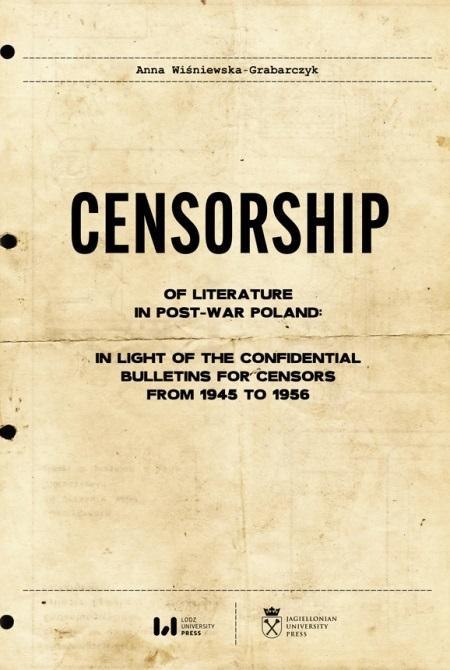
Censorship of Literature in Post-War Poland in the Light of Confidential Bulletins for Censors from 1945 to 1956, reconstructs and presents ways to censor literature (and, contextually, other fields of art) submitted for evaluation to the main censorship office in Poland during the first 11 years after WWII. The source material consists of confidential Bulletins periodicals addressed to the officials of the censorship office.
Part One: In Search of a Definition: What Were the Confidential Bulletins for Censors? Characteristics of the Source Material presents basic information about the Bulletins their goals, structure, and material presented in them. The analysis concludes with the definition of confidential Bulletins of the censorship office.
Part Two: Literature and Current Literary Phenomena Preconstructs the image of literary life presented in the Bulletins from 1945 to 1956. On numerous occasions, the Bulletins provided helpful guidelines in censorship practice. They discussed the job of dealing with literary texts and often gave examples of works published just a few months earlier or those that had not passed the scrutiny.
The authors focus on a relatively neglected field of censorship research the bulletins and attempt to provide a systematic account of their role and nature marks the key innovative aspect of the work. I deeply appreciate and admire the colossal labour that the author has undertaken to produce the text, especially in the extremely difficult circumstances that we have had to endure these past two years.
Dr. John M. Bates, University of Glasgow
The reviewed publication will enable foreign readers to get an insight into how the system of control and repression operated in Poland during the Stalinist era. Furthermore, it will familiarize them with the history of Poland, including Polish literature of that period.
Prof. Kamila Kamińska-Chełminiak, University of Warsaw
Wiśniewska-Grabarczyks monograph is based on rich source material and is of great intellectual value. The publication of the book in English will further research on communist censorship in Central and Eastern Europe in the context of comparative analysis.
Prof. Sławomir Buryła, University of Warmia and Mazury in Olsztyn
Parametry:
Autor:
Anna Wiśniewska-Grabarczyk
Wydawnictwo:
Wydawnictwo Uniwersytetu Jagiellońskiego
Stron:
374
Rok wydania:
2022
Oprawa:
broszurowa
Informacje dotyczące bezpieczeństwa
Wszystkie produkty zostały zaprojektowane z dbałością o jakość i bezpieczeństwo użytkowania. Przed pierwszym użyciem zaleca się dokładne zapoznanie się z opisem oraz instrukcją produktu.
Produkty przeznaczone dla dzieci powinny być używane wyłącznie zgodnie z ich przeznaczeniem i – w przypadku młodszych użytkowników – pod nadzorem osoby dorosłej. Należy usunąć elementy opakowania (folię, opaski, etykiety) przed przekazaniem produktu dziecku.
Książki przeznaczone dla dzieci powinny być dopasowane do wieku i poziomu rozwoju czytelnika. Zaleca się wspólne czytanie z rodzicem lub opiekunem w przypadku młodszych dzieci.
Producent oraz sklep dokłada wszelkich starań, aby oferowane produkty spełniały aktualne normy bezpieczeństwa. Odpowiedzialność za bezpieczeństwo, jakość wykonania oraz zgodność produktu z obowiązującymi normami ponosi producent. W razie wątpliwości dotyczących użytkowania lub bezpieczeństwa produktu zaleca się kontakt z producentem lub zapoznanie się z informacjami umieszczonymi na opakowaniu.
Dane producenta
Uniwersytet Jagielloński - Wydawnictwo Uniwersytetu Jagiellońskiego
Gołębia 24
31-007 Kraków
Poland
biuro@wuj.pl
Nie ma jeszcze komentarzy ani ocen dla tego produktu.